




HPV Screen
Detect 14 high-risk HPV infections with our non-invasive at-home tampon screening kit.
- Non-invasive, at-home screen
- Personalised, actionable results
- Access to prescription treatments to your door


Frequently bought together


Who is this service for?
If you had HPV in the past
If you had HPV in the past
Track if your HPV infection persists to help prevent the development of cervical cancer.
We suggest screening once every year to monitor your health.If your busy lifestyle gets in the way
If your busy lifestyle gets in the way
At-home testing for HPV with a tampon is a convenient, easy way to stay on top of your gynae health.
We suggest a one-off screen to identify all treatable issueIf you find in-clinic exams invasive
If you find in-clinic exams invasive
The Diagnostic Tampon is designed to be a discreet and non-invasive way to detect HPV from the comfort of your safe space.
We suggest 1-2 screens per year, and anytime you have symptoms.The Human Papillomavirus (HPV), mainly transmitted through sexual contact, causes nearly all cervical cancer cases. Studies suggest around 80% of people will contract HPV at some stage in life, often without symptoms.
Which pathogens do we test for?
With cutting-edge PCR technology for unparalleled accuracy, Daye tampons collect more vaginal fluid than a standard swab and cover the whole vaginal canal.
HPV screening
Detects the presence of high risk human papillomavirus strains.
*Only available with the HPV Screen
Lactobacilli
Good bacteria in your vaginal microbiome.
Anaerobic bacteria
Cause infections like bacterial vaginosis (BV).
Candida
Candida is a fungus which affects 75% of women.
Mycoplasma/ Ureaplasma
According to studies, can affect fertility.
Chlamydia
A very common STI caused by a bacterial infection.
*Only available with the STI Screen
Gonorrhoea
An STI that can affect both men and women.
*Only available with the STI Screen
Trichomoniasis
One of the most common STIs worldwide.
*Only available with the STI Screen
Herpes Type I & II
Can potentially infect another person.
*Only available with the STI Screen
What is included with every screening?
Order your test & get a kit delivered to your door
The kit will arrive at your doorstep in a discreet package. No more awkward queuing in clinic waiting rooms.

Collect and send off your sample to our accredited lab
Activate your kit with your unique code, complete a short symptom questionnaire, and send your sample - we'll handle the rest.

Get detailed, actionable results.
We never want to leave you stuck with a set of confusing or potentially troubling results. If you test positive for an STI, one of our sexual health nurses will provide a free consultation.
Connect with vetted specialists & get prescription treatments to your doorstep.
After the screening, you can set up virtual consultations with our vetted sexual health, fertility, and menopause experts. You can also get treatments discreetly delivered to your door.

Discover simple changes you can implement to take control of your health
Every report includes science-backed, personalised insights into lifestyle changes you can adopt to further enhance your health.

Be your own health hero
Got a recurring infection?
Got a recurring infection?
Mainstream treatments for BV and thrush can put us at a higher risk of recurrent infections.
Learn moreOwn your fertility journey.
Own your fertility journey.
A healthy microbiome is vital for successful fertilisation, implantation, and embryo development.
Learn moreWorried about STIs?
Worried about STIs?
As many as 70% of female STIs are asymptomatic, making proactive screening essential.
Learn more


Choose a screen that works for you
HPV + Microbiome + STI Screen
£277
What we test for:
HPV16
HPV18
12 other high-risk HPV types
Lactobacilli
Common BV related bacteria
Candida
Mycoplasma hominis
Ureaplasma
Gonorrhea
Chlamydia
Trichomoniasis
Mycoplasma genitalium
HPV + Microbiome Screen
£188
What we test for:
HPV16
HPV18
Other high-risk HPV types
Lactobacilli
Common BV related bacteria
Candida
Mycoplasma hominis
Ureaplasma
HPV Screen
What we test for:
HPV16
HPV18
Other high-risk HPV types
See our Founder’s results!
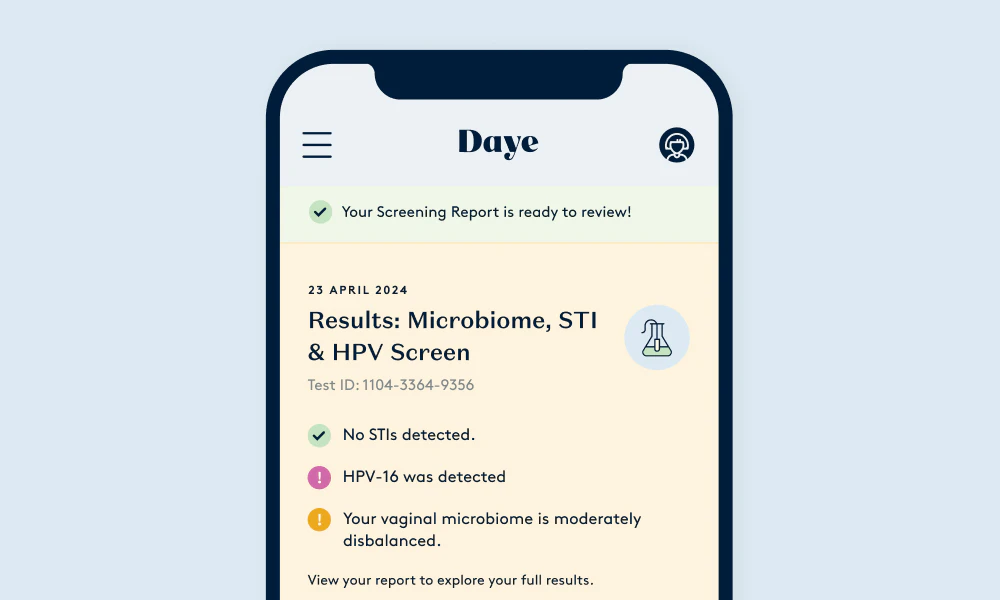
Wondering what we test for, and what results look like? Enter your email below and Valentina, our Founder, will send you her screening report.
By entering your email above you agree to receive marketing emails and promotions from Daye.


Your data is for your eyes only
Protecting your privacy is the least we can do
Frequently asked questions
Still have questions? Read all of our FAQs.
Relevant Research
The vaginal microbiota associates with the regression of untreated cervical intraepithelial neoplasia 2 lesions
2020 • Anita Mitra, David A MacIntyre, George Ntritsos, Ann Smith, Konstantinos K Tsilidis, Julian R Marchesi, Phillip R Bennett, Anna-Barbara Moscicki, Maria Kyrgiou
Emerging evidence suggests associations between the vaginal microbiota (VMB) composition, human papillomavirus (HPV) infection, and cervical intraepithelial neoplasia (CIN); however, causal inference remains uncertain. Here, we use bacterial DNA sequencing from serially collected vaginal samples from a cohort of 87 adolescent and young women aged 16-26 years with histologically confirmed, untreated CIN2 lesions to determine whether VMB composition affects rates of regression over 24 months. We show that women with a Lactobacillus-dominant microbiome at baseline are more likely to have regressive disease at 12 months. Lactobacillus spp. depletion and presence of specific anaerobic taxa including Megasphaera, Prevotella timonensis and Gardnerella vaginalis are associated with CIN2 persistence and slower regression. These findings suggest that VMB composition may be a future useful biomarker in predicting disease outcome and tailoring surveillance, whilst it may offer rational targets for the development of new prevention and treatment strategies.
The vaginal microbiome: A complex milieu affecting risk of human papillomavirus persistence and cervical cancer
2022 • Stephanie Alimena, Joshua Davis, Raina N. Fichorova, Sarah Feldman
The purpose of this review is to describe the existing literature regarding the relationship between the vaginal microbiome, human papillomavirus persistence, and cervical cancer risk, as well as to discuss factors that mediate these relationships. Data suggest that alterations in the vaginal microbiome affect the risk of human papillomavirus infection and persistence, which has downstream effects on cervical dysplasia and cancer risk.
Role of Immunity and Vaginal Microbiome in Clearance and Persistence of Human Papillomavirus Infection
2022 • Lungelo Ntuli, Andile Mtshali, Gugulethu Mzobe, Lenine JP Liebenberg, Sinaye Ngcapu
Recently, diverse vaginal microbiome (associated with bacterial vaginosis) and genital inflammation have emerged as potential drivers of high-risk HPV positivity and disease severity in women. The potential role of these risk factors on HPV recurrence and persistence remains unclear. This article reviews the role of cellular or cytokine response and vaginal microbiome dysbiosis in the clearance, persistence, and recurrence of HPV infection.
Long-term Absolute Risk of Cervical Intraepithelial Neoplasia Grade 3 or Worse Following Human Papillomavirus Infection: Role of Persistence
2010 • Susanne K. Kjær, Kirsten Frederiksen, Christian Munk, Thomas Iftner
HPV16, HPV18, HPV31, and HPV33 infection and especially HPV16 persistence were associated with high absolute risks for progression to high-grade cervical lesions. The results indicate the potential value of genotyping in cervical cancer screening. Given that HPV DNA–negative women retained their low risk of CIN3 or worse for many years, frequent screening of these women may be unnecessary.
Oral cancer risk in relation to sexual history and evidence of human papillomavirus infection
1998 • S M Schwartz, J R Daling, D R Doody, G C Wipf, J J Carter, M M Madeleine, E J Mao, E D Fitzgibbons, S Huang, A M Beckmann, J K McDougall, D A Galloway
Experimental models and analyses of human tumors suggest that oncogenic, sexually transmittable human papillomaviruses (HPVs) are etiologic factors in the development of oral squamous cell carcinoma (SCC). We conducted a population-based, case-control study to determine whether the risk of this cancer is related to HPV infection and sexual history factors. HPV type 16 infection may contribute to the development of a small proportion of oral SCCs in this population, most likely in combination with cigarette smoking.
Efficacy and Acceptability of Self-Collected Medical Grade Tampon as a Novel Vaginal Sample Collection Tool for the Detection of HPV and STIs
2024 • Valentina Milanova, Iva Lazarova, Kalina Mihaylova, Michelle Gomes, Teodora Georgieva, Jan Multmeier
Self-collected tampons demonstrated promising diagnostic accuracy to HCW-collected swabs for HPV and STI detection. The tampon self-collection method was well-accepted and preferred by participants, suggesting its potential as an alternative screening tool, particularly in low-resource settings. Further research with larger and more diverse populations is recommended to validate these findings and inform tampon-based self-collection programs for cervical cancer screening. Randomised controlled trials and comparisons with gold standard methods would enhance validation.
Tampons: A Novel Patient-Administered Method for the Assessment of Genital Human Papillomavirus Infection
1992 • Christopher K. Fairley, Shujun Chen, Sepehr N. Tabrizi, Michael A. Quinn, John J. McNeil, Suzanne M. Garland
Assessment of human papillomavirus (HPV) infection usually requires a speculum examination to collect genital specimens. A technique using tampons as.a patient-administered method for the collection of specimens was studied by dot blot hybridization (HPV types 6, 11, 16, 18, 31, and 33) and polymerase chain reaction (PCR). Tampons and cervical scrapes were collected from 48 consecutivewomen attending a dysplasia clinic. Tampons provided a significantlylarger pellet volume (P < .002) and more DNA (P < .01) than scrapes. There was a close correlation when samples were analyzed for the presence of HPV DNA. Using dot blot hybridization, 8 cervical scrapes (17%) and 9 tampons (19%) were positive for HPV DNA (90% correlation). By PCR, 35 cervical scrapes (73%) and 33 tampons (69%) were positive for HPV DNA (88% correlation). Thus, tampon specimens are an easy method for assessment of genital HPV infection.